
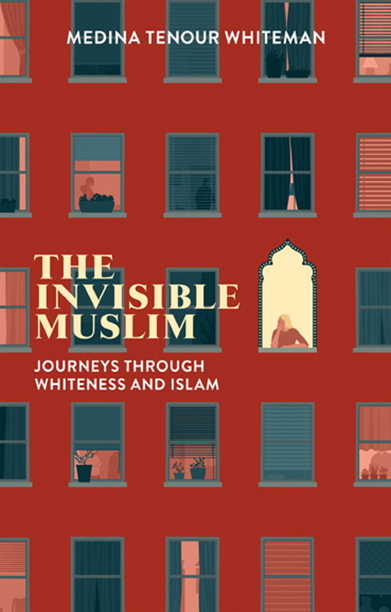
The Invisible Muslim: Journeys Through Whiteness and Islam by Medina Tenour Whiteman, C. Hurst & Co. (Publishers) Ltd., 2020, 278 pages
What is home? What does it mean to make a place a home? Your home. For most home is a base camp. It’s a place where you live, often times with others as a family, in a household. It matters not whether your home is a small cottage or a swanky high-rise apartment. The tangibility is irrelevant. Rather, what’s more important is that home becomes your place of solitude where you are free to be who you are. It is a place where you feel like you truly belong. That feeling is one of the core innate elements that human beings desire which is to be part of something special, to be part of something important that is greater than just ourselves.
As human beings we’re socialised to conduct ourselves accordingly so that we would be accepted and deemed worthy by our peers; and be included as part of that social group. Otherwise we risk ostracization and end up living on the fringes, unable to conform and integrate to one or many social groups. By immersing and integrating into a community of like-minded individuals, we feel more “at home”, we feel that we belong amongst this specific community of people.
Writer, poet and musician Medina Tenour Whiteman in her searing memoir The Invisible Muslim: Journeys Through Whiteness and Islam offers a rare insight into reconciling the interlacing threads of religion, ethnicity, and race, with her personal identity. Medina’s background is a kaleidoscope of Anglo-American heritage, born to Sufi Muslim parents. Growing up, her family moved to Andalusia, Spain, to be part of the burgeoning Sufi community at that time. Eventually her family moved to the United Kingdom where they decided to settle in the county of Essex. Following that, she moved to Granada, Spain where she now resides. Her journeys made throughout her memoir expand far and wide from Bosnia and Kenya, all the way to Ladakh in the Himalayas.
In the introduction to The Invisible Muslim, Medina painfully describes her internal struggles as wanting to be her true authentic self, but finds that she’s often at the whims of the company that surrounds her. She describes that being “part of the team” wins in favour of how she conducts herself, thus never feeling truly at home with herself. Tellingly, her flexibility to adjusting her social conduct is predicated on the basis that her Whiteness and Europeanness is automatically construed as her being “non-Muslim”; an open admission Medina lays claim herself.
The memoir at times reads like an open and frank discussion, with Medina holding a mirror against herself. On Whiteness, she makes bold introspective statements that aim to reach the psyche of not just White Muslims, but White people themselves. In one account aimed at highlighting systemic racism, she signifies that “White people know deep down that our advantages were not earned and have come to us through violent discriminatory means”. A declaration that if one decides to reduce the capacity of racism to just an individual’s moral failings, then we’ll never truly be able to challenge the racial hierarchy. Her solution to this lies in breaking the social stigma amongst White people by talking openly about race, so that it “disrupts the illusion that our Whiteness is normal”. A sentiment echoed by Reni Eddo-Lodge in her book “Why I’m No Longer Talking to White People about Race”.
But this is not a book about self-flagellation, it’s not about White guilt. By balancing the see-saw scale of being White European and Muslim, Medina throughout her travels has constantly found herself at odds with the local customs and its populace, indeed also when living in the UK. The constant battle of too much, too little is reflected especially on the topic of hijab, where the author would regularly have to contend with comments from other people on what constitutes a perfect Muslim that also has other identities attached, such as European and White. Wear a hijab and you’re too religious, don’t wear a hijab and you’re not religious enough; further accentuated by one’s fair complexion where it becomes a balancing act of being perceived as trying too hard/not trying hard enough. An issue synonymous from her time spent in Kenya, the UK, and Tanzania.
Becoming known within Muslim circles, the author’s Whiteness and Europeanness had also become a glaring bone of contention where people would offer their sons to marry her on the grounds of her complexion. A depressing point from her latter chapter on sex and relationships that’s also worthy of mention is that Black Muslim women would be regarded as less desirable for marriage than their fairer skinned cohorts. Medina notes that by wielding the double-edged sword of being a White Muslim, it leads to them being taken more seriously than their non-White peers in giving sermons, or in preaching the word of the religion to non-Muslims so that they’d come across as more “palatable”. By inadvertently elevating the position of White Muslims, Medina thus holds the mirror against the non-White Muslim population in their complicity of acting in discrimination, despite its religion’s own emphasis on tolerance and multiculturism.
The author’s time spent in Bosnia and Herzegovina offers one of the rarer examples of where her mixed identities would coalesce. The country’s violent and brutal past help explain the relaxed relations between its religious communities. Treating individuals from different religious backgrounds with warmth and equality, what Medina calls “a beautiful synthesis of Balkan stoicism”, offers lessons in humility. It made for a special occasion in her life as her proclaimed identity was not met with strange looks, but rather a genuine acceptance.
The Invisible Muslim eloquently highlights the tender triumvirate balance of religion, ethnicity and racial identities that form the nuances of interactions between Muslims from a diverse palette of backgrounds. It dismantles the idea that Islam is a monolith, a trope that seeks to expunge 1,400 years of the religion’s diverse and complex history. Few memoirs are so frank and honest in conversation over what is a rarely considered subject amongst Muslims and non-Muslims alike. The invisible Muslim is an open-hearted memoir that seeks to bridge that understanding.
Available to purchase from Hurst Publishers at: https://www.hurstpublishers.com/book/the-invisible-muslim/
Follow Medina Tenour Whiteman on Instagram at:
@medinatenour
 Sameer Qureshi